
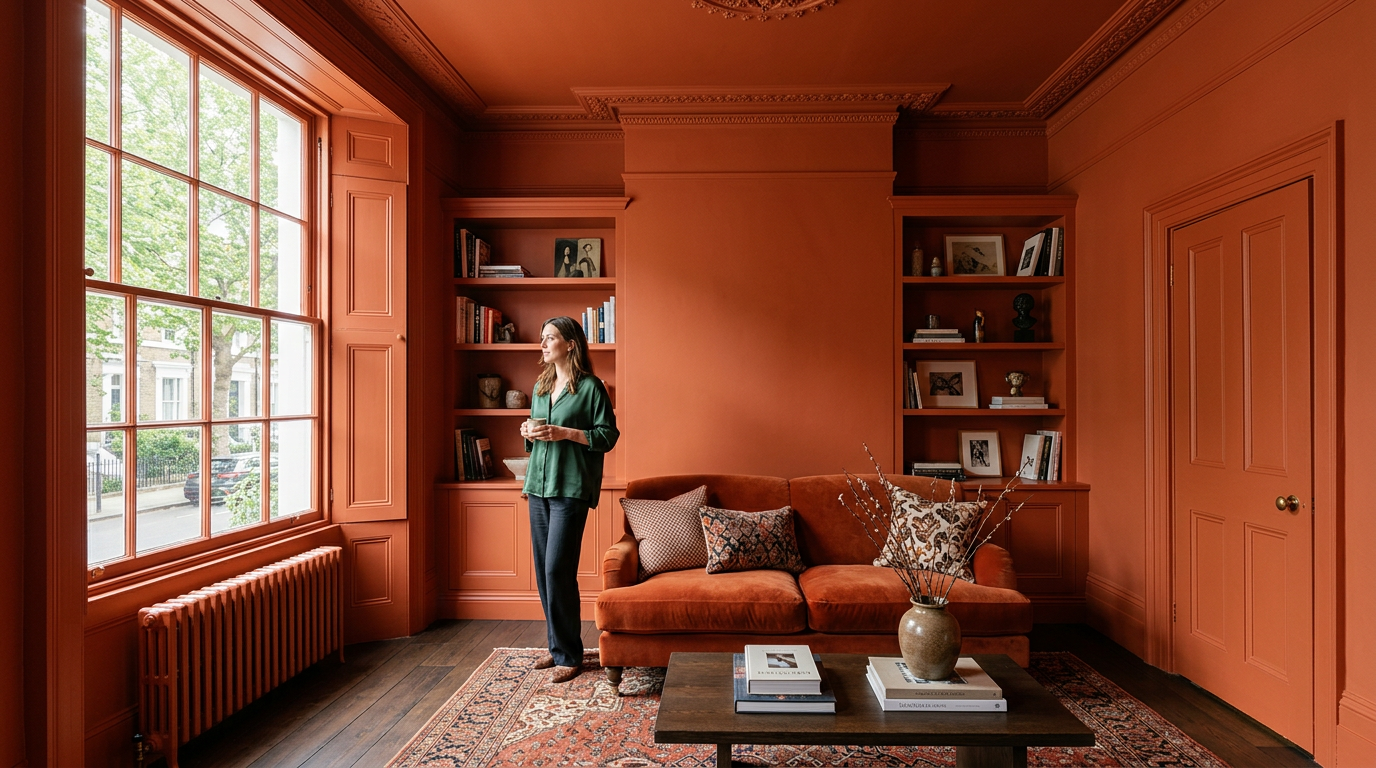
For years the rulebook said the same thing: white ceiling, white trim, one brave accent wall if you were feeling reckless. Then designers started painting entire rooms — walls, woodwork, ceiling, radiators, the lot — in a single saturated shade, and something unexpected happened. The rooms felt bigger, calmer and far more expensive.
We have a soft spot for any trend that rewards nerve over budget, and color drenching is exactly that. Here are 8 ways to pull it off without overwhelming your room.
1. Start With a Room That Can Take It


Color drenching works hardest in the spaces most people avoid painting: small, dark or awkward rooms. A windowless powder room, a snug, a box bedroom, a hallway with five doors — these are the rooms where white paint only highlights the flaws. Wrapping them in one deep color hides the awkward angles and turns a problem space into the most memorable room in the house.
2. Choose Your Shade Like You Mean It


Timid colors get lost in this technique. Deep, complex shades — ink blue, olive, oxblood, chocolate, forest green, even a moody plaster pink — hold up when they cover every surface. Test properly: paint a large sheet of paper, move it around the room, and look at it in morning light, lamplight and evening. A shade that charms you at 10am can turn muddy by dusk.
3. Paint Everything — Yes, Even the Trim


This is the part people flinch at, and it is the part that actually makes it work. Skirting boards, door frames, the door itself, window reveals, built-in shelving, the radiator, the ceiling. When the eye stops finding edges and breaks, the room reads as one continuous, enveloping space — which is exactly why drenched rooms feel larger, not smaller.
4. Play With Finish Instead of Color


One color does not mean one texture of paint. Use a flat or matte finish on the walls and ceiling, then a satin or eggshell on the trim, doors and radiator. Same shade, different sheen — the light catches the woodwork just enough to keep architectural details visible, and the room gains depth without breaking the spell.
5. Let Texture Do the Talking


When color stops competing for attention, texture becomes the main event. Layer bouclé, velvet, linen, rattan, aged wood and something with a bit of sheen. A drenched room with flat, samey furnishings can feel like a stage set; the same room with three or four contrasting textures feels collected and deliberately designed.
6. Give the Eye Somewhere to Land


Total immersion needs one moment of relief. A large mirror, a gilt frame, a brass lamp, a pale rug or a stack of light-spined books gives the eye a resting point and stops the room tipping from cocooning into claustrophobic. One or two of these is plenty — this is punctuation, not a second color scheme.
7. Mind Your Lighting


Deep color absorbs light, so a single overhead bulb will make a drenched room feel like a cave. Layer it instead: a table lamp, a floor lamp, a wall light, ideally with warm-toned bulbs. The payoff is genuinely lovely — saturated walls under warm lamplight glow in a way that white walls simply never manage after dark.
8. Commit, Then Stop

The most common mistake is half-drenching — painting the walls and ceiling, then leaving white trim and a white door, which reads as unfinished rather than bold. Either go all the way or choose a different look entirely. And once you have committed, resist adding more decor to compensate. The color is the statement; everything else is just supporting cast.
Color drenching is proof that the boldest decision in a room is often the simplest one — pick a shade you love, and let it take over. Which room in your home is secretly begging for it? Let us know in the comments!




Zostaw odpowiedź