
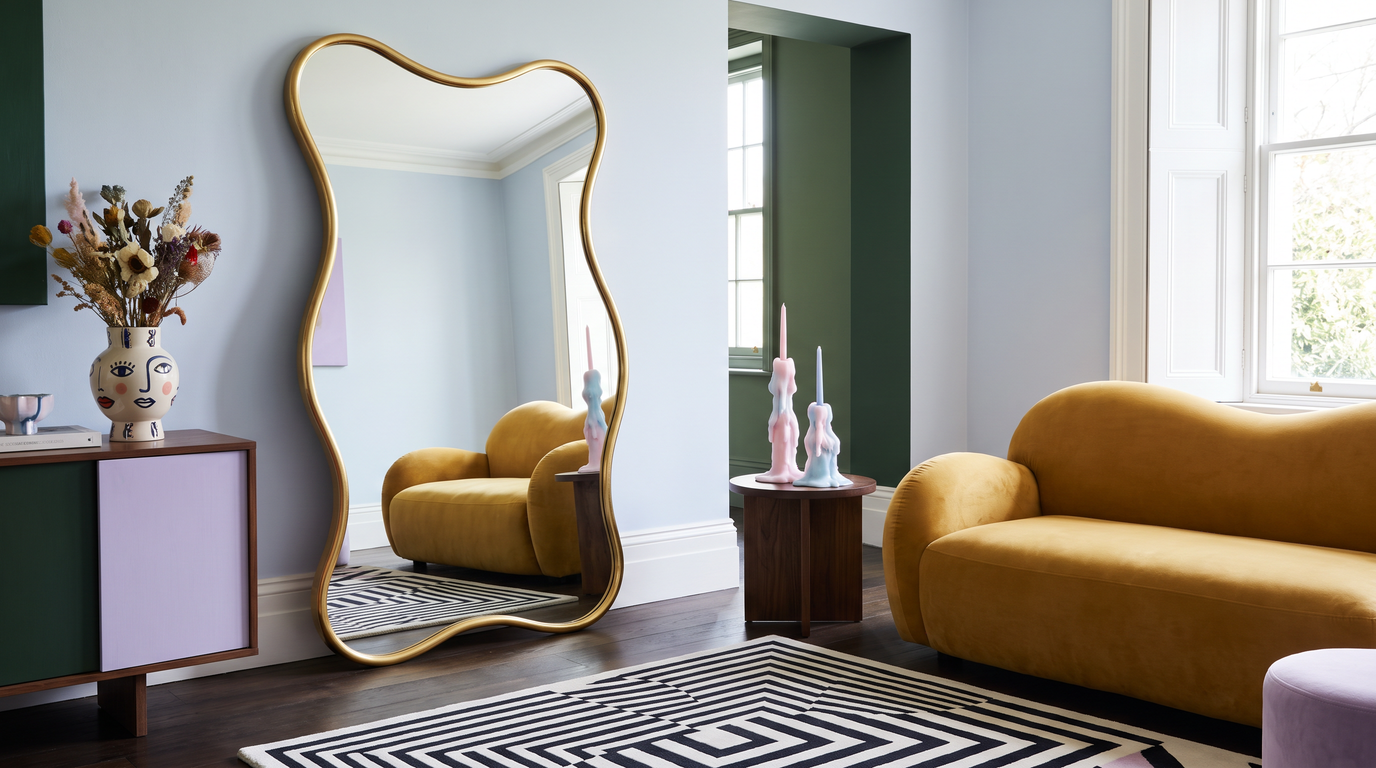
Surrealism has quietly crept out of the gallery and into the living room, and it is doing something that beige maximalism never managed: it makes people stop and look twice. The risk, of course, is the fine line between a room that feels dreamlike and a room that feels like the window display of a shop you would not go into.
At Circus of Wonders, we think the difference comes down to quantity rather than courage. One strange object in an otherwise calm room is surreal. Six of them is a theme park. Here are 6 ways to get the dream and skip the prop shop.
1. Hang a Mirror That Has Melted Slightly


A wavy or asymmetric mirror does something a rectangular one cannot: it makes the wall feel soft. Hang it where people pass rather than where they study their reflection, so a hallway or the end of a landing. Keep the frame plain and the glass clear. The shape is already doing the talking, and a gold baroque frame on top of it tips straight into kitsch.
2. Let the Candle Holders Misbehave


Twisting, drooping or vaguely molten candlesticks are the cheapest entry point to this whole look, and they work because they are small. Buy them in brass or matte ceramic rather than bright colors, group three at different heights, and put them somewhere you actually light candles. Surreal objects earn their place faster when they still do their job.
3. Buy One Piece of Furniture With No Straight Lines


Blob sofas, cloud armchairs, kidney tables. The trick is to own exactly one and let everything around it stay rectangular, because a curved piece reads as sculpture only when there is geometry to push against. Fill a room with curves and the effect collapses into a soft play area. Secondhand nineteen-seventies seating is still the best value here by a distance.
4. Add One Face, Eye or Hand


A hand-shaped vase, a vessel with a profile pressed into it, a single eye in a framed print. This is the motif that most often goes wrong, and the rule is brutal: one per room. Two is a collection, three is a horror film. Choose plaster, terracotta or unglazed stone over anything glossy, so the object reads as artefact rather than novelty gift.
5. Put the Illusion on the Floor


An optical rug is the most forgiving way to do surrealism, because the floor is the one surface nobody stares at directly. Impossible staircases, warped checkerboards, spirals that refuse to resolve. Keep the palette to two colors so the pattern stays legible, and let the rug be the only patterned thing in the room. Everything else stays quiet.
6. Pair Colors That Should Not Work


This is where the dream actually lives. Lilac with mustard, deep navy with coral, sage with dusty rose. The pairings feel wrong for about a week and then feel inevitable. For the fully surreal version, run a soft gradient up a wall so the color fades like mist rather than stopping at a line, which costs a tester pot and an afternoon.
Surreal decor is the rare trend that rewards buying less rather than more, because the strangeness only reads when there is calm around it. Which one would you risk first, the melted mirror or the impossible rug? Let us know in the comments!




Leave a Reply