
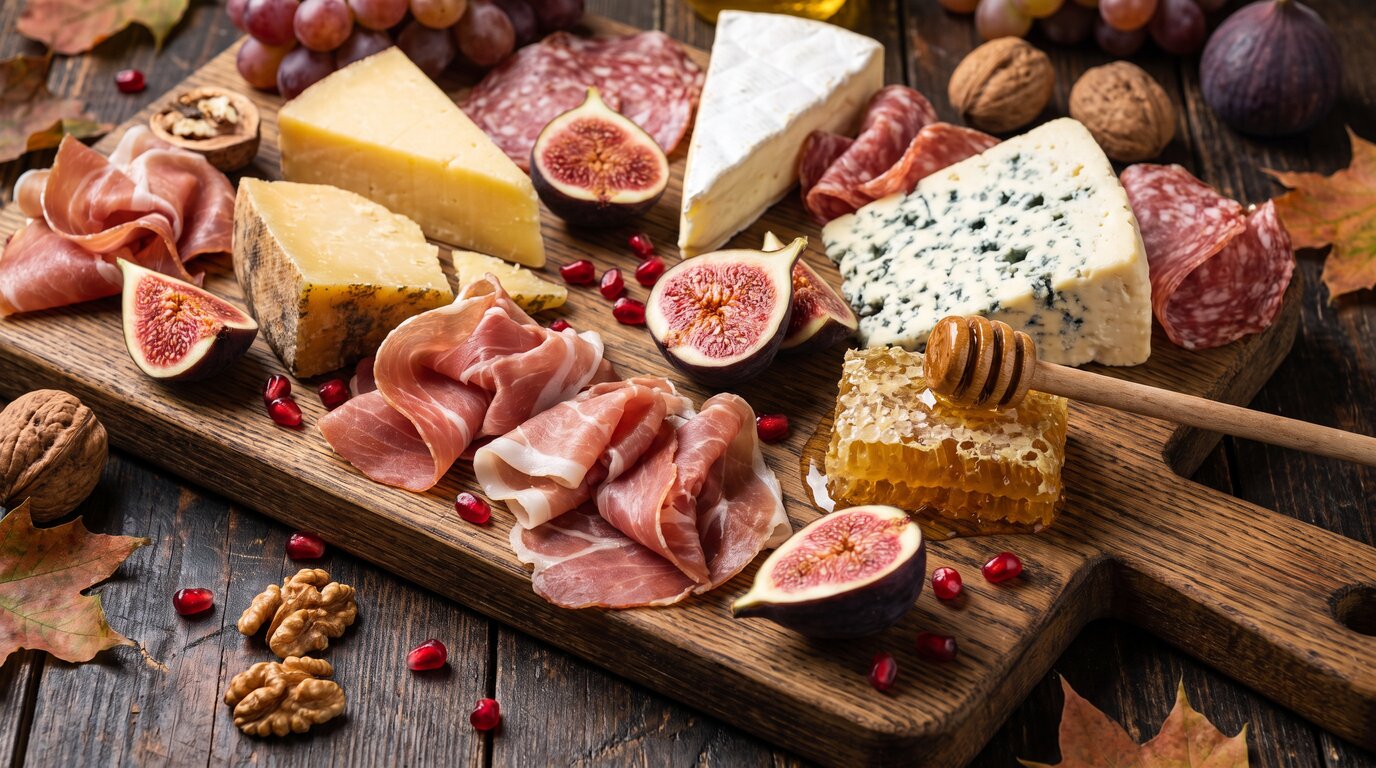
A grazing board is the only dish in the world that gets better the less you cook. Nothing on it is made, everything on it is bought, and the entire skill is deciding where things go. Which means the gap between a board that looks thrown together and one that looks like it came out of a magazine is not money, and it is certainly not talent. It is about six rules, all of which can be learned in the time it takes to read this.
At Circus of Wonders we are deeply in favour of anything that photographs better than it deserves to, and autumn produce does most of the work for free. Here are 9 grazing boards built on figs, pomegranate, honeycomb and a great deal of unearned confidence, each one assembled in roughly twenty minutes.
1. Three Anchors, Spaced Apart


Before anything else, put three cheeses down in a wide triangle, nowhere near each other. That is the entire skeleton. A soft round, a hard wedge and something crumbly, each in a different corner, and the rest of the board becomes a filling-in exercise rather than a decision. The most common mistake is clustering everything in the middle and then having nowhere to go.
2. Fold the Meat, Never Lay It Flat


Flat slices look like a supermarket tray. Fold each slice into quarters and stand them on edge in a loose river, or pinch them into rough rosettes. It takes about ninety seconds for a whole packet and it is the single biggest visual upgrade on this list, because it is the only thing on the board with real height.
3. Halve the Figs So You Can See Inside


Whole figs are small purple lumps. Halved figs are the reason anyone photographs an autumn board at all, because the inside is a colour you cannot buy. Cut most of them, leave two or three whole for contrast, and lay the cut halves facing up along a diagonal rather than scattered. Quartering a couple gives you a third shape for free.
4. One Square of Honeycomb Does the Heavy Lifting


A single piece of honeycomb set against the hard cheese is the cheapest luxury signal available. It catches light the way nothing else on the board does, it slumps slightly as the room warms up, and it is the one element guests reliably ask about. One square is plenty. Two looks like you are trying.
5. Pomegranate Is a Scatter, Not a Pile


A heap of pomegranate seeds in a bowl reads as leftovers. The same seeds flicked across the whole board in ones and twos read as styling, and they fall into exactly the small gaps you cannot otherwise fill. Do this last, after everything else is placed, and be meaner with them than feels right.
6. Stand the Crackers on Edge in a Curve


Crackers laid flat are a stack. Crackers tipped onto their edges and pushed into a slow S-curve across the board are a design feature, and they hold the shape because they lean on each other. It also doubles the number you can fit. Run the curve past the cheeses rather than around the outside.
7. Something Green That Is Not Parsley


Three sprigs of rosemary, a few sage leaves or a small bunch of grapes still on the stem will cover every remaining gap and make the whole thing look picked rather than shopped. Tuck the stems underneath the cheese so only the leaves show. Avoid anything frilly, and avoid covering more than about a fifth of the board.
8. One Small Bowl, Off-Centre


A board is relentlessly flat until something round interrupts it. A small ceramic bowl of honey, fig jam or olives placed off-centre does that job, and it stops the eye sliding straight off the edge. One bowl, not three, and never in the middle. Everything else can then lean against it, which saves you arranging the gap around it.
9. The Twenty-Minute Order of Operations


Cheese first, meat second, the two or three big fruits third, crackers fourth, herbs fifth, pomegranate last. Working outside-in or in any other order means moving things you have already placed, which is where the twenty minutes turns into an hour. Take everything out of its packaging before you start and put the board down on the table, not the counter.
None of this is cooking and all of it is arrangement, which is the best news a host gets all season. Space your anchors, give one thing height, cut the fruit so the inside shows, and resist filling every square centimetre — a board needs a little bare wood to look deliberate. Which of these would you actually put together this weekend? Let us know in the comments!
Leave a Reply