
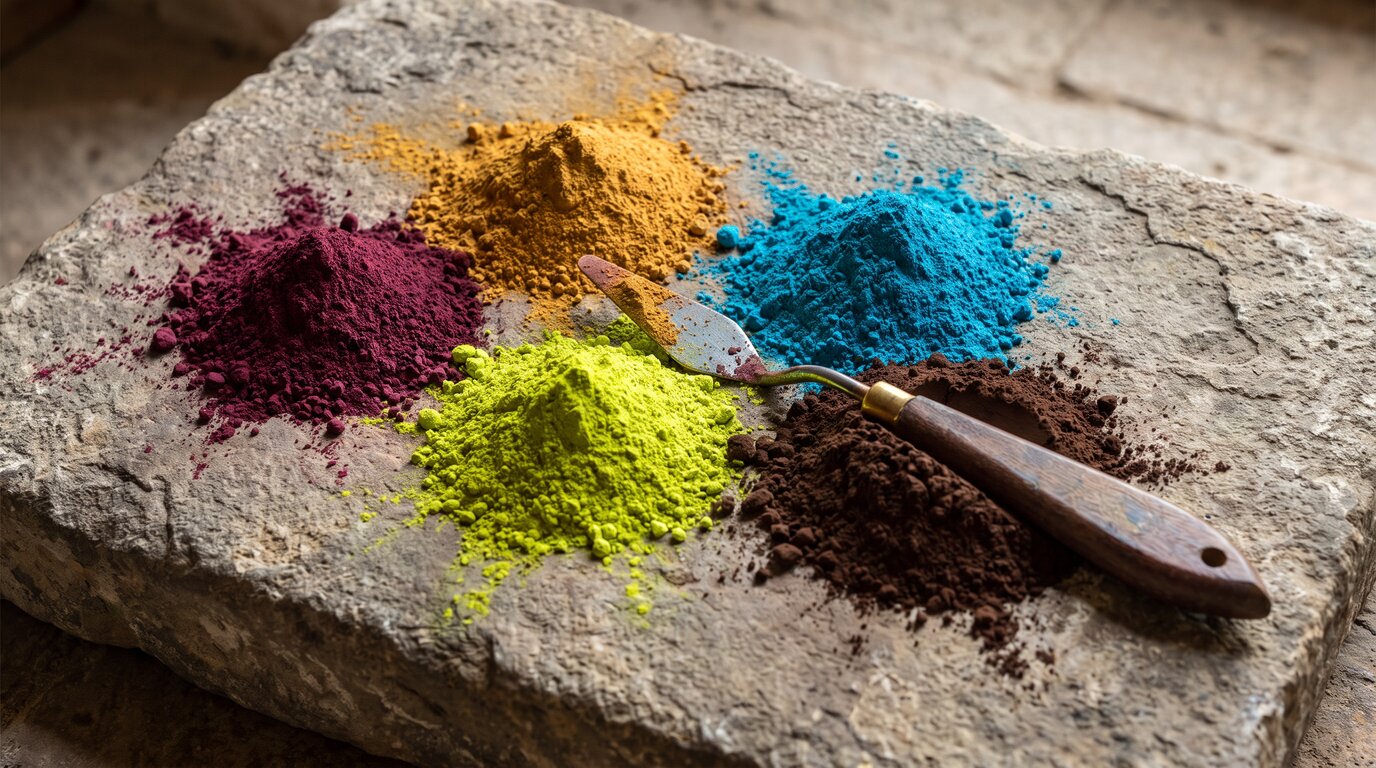
For most of history a colour was a substance you had to find, dig up, boil, grind or poison yourself with. Some of those substances ran out. Some turned out to be killing the people who used them. One was made of actual human remains, and the firm that sold it kept going until the supply of bodies finally failed.
At Circus of Wonders, the history of colour is the least boring history there is. Here are 12 pigments the world stopped making, what each of them actually looked like, and why it is no longer on anybody’s shelf.
1. Mummy Brown


Exactly what it sounds like: Egyptian mummies, human and feline, ground up with pitch and myrrh into a warm transparent brown. It was sold from the sixteenth century onwards, often to painters who had no idea what they were using. The London colourmaker that made it told a reporter in 1964 that it had simply run out of mummies.
2. Tyrian Purple


Extracted from a gland in murex sea snails, this deep red-purple was the colour of Roman emperors and was priced accordingly. Estimates of how much it took vary enormously between sources, from several thousand snails for a single gram up to a hundred kilograms of them. The method was effectively lost after 1453 and has only been reconstructed by a handful of people.
3. Indian Yellow


A luminous deep gold that glowed from inside a painting. The story attached to it, that it was made from the urine of cows fed nothing but mango leaves, is genuinely disputed: some chemical analysis of old samples supports it, other historians call it a colonial-era rumour. Production ended early last century and today’s version is synthesised instead.
4. Scheele’s Green


A copper arsenite green invented in the 1770s and immediately put into everything: wallpaper, dresses, children’s toys, artificial flowers. The colour was unmatched and the arsenic was not optional. Damp Victorian rooms papered in it were quietly releasing poison, which did not stop it selling until a similar, equally toxic green replaced it.
5. Orpiment


A brilliant lemon-gold mineral whose name comes from the Latin for golden paint, and which is also arsenic sulphide. Painters knew it was dangerous and used it anyway, because nothing else gave that particular metallic yellow. It also reacts badly with lead and copper pigments, so paintings containing it have often darkened where the colours met.
6. Realgar


Orpiment’s orange-red cousin and chemically its close relative, which means equally poisonous. Realgar has the additional flaw of being unstable in light: over decades it breaks down into a dusty yellow powder, so paintings that once had glowing orange passages now have pale patches where the colour used to be.
7. Lead White


The white underneath almost every old master, made by exposing coiled lead to vinegar fumes and dung heat. Nothing since has matched its warmth or the way it handles under a brush. It is also lead, and the people who made it rarely lasted long in the trade. Titanium white replaced it, behaves completely differently, and painters still complain.
8. Chrome Yellow


A fierce lead chromate yellow that arrived in the early nineteenth century and gave painters a brightness they had never had. It is both lead and chromium, which is two problems rather than one, and it has long since been pushed out by cadmium and modern organic yellows that do the same job without the warnings.
9. Egyptian Blue


The oldest synthetic pigment known, found on objects dating back more than five thousand years and made by firing sand, copper and lime together. It went out of use after the Roman period and the recipe went with it. Its strangest property only emerged recently: it glows under infrared, so conservators can now find invisible traces of it on objects that look bare.
10. Maya Blue


Not a mineral but a hybrid: indigo bonded into palygorskite clay with heat, which produced a turquoise that laughed at centuries of jungle humidity. Murals painted with it are still vivid where everything around them has rotted. The technique was lost with the civilisation that invented it and took modern chemists a long time to work out.
11. Verdigris


The blue-green crust that forms when copper meets vinegar, scraped off and sold as paint. Fresh verdigris is a startling emerald that no modern green quite replicates. Unfortunately it keeps reacting: it darkens, turns brown, and in manuscripts it will eventually eat straight through the page it was painted on.
12. Dragon’s Blood


A dark red resin that bleeds from certain trees, which medieval Europe cheerfully believed was the mingled blood of a dragon and an elephant who had killed each other. The resin is real and still obtainable. The colour, however, fades badly in light, which is why it survives as an incense and a varnish tint rather than as serious paint.
Nearly every colour on this list was abandoned for one of three reasons: it ran out, it was poisonous, or nobody could remember how to make it. Modern tubes are safer, more stable and, in a few cases, genuinely less beautiful. Which one would you most like to see back? Let us know in the comments!
Leave a Reply