
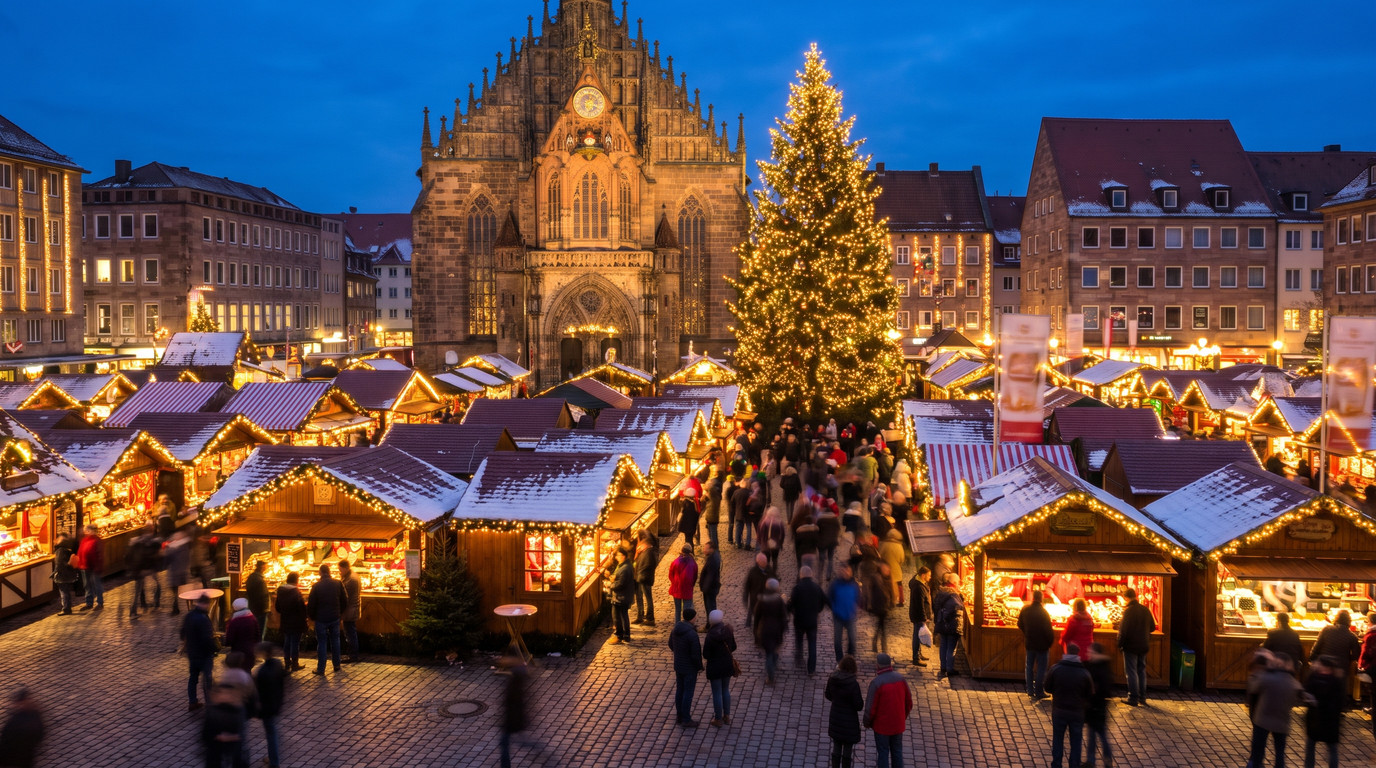
Every Christmas market photograph is taken at the same moment: blue hour, fresh snow, nobody in the frame. Then you arrive at two in the afternoon on the second Saturday of December and discover that the postcard view is occupied by four hundred people and a refuse bin. The markets themselves are rarely the problem. The timing almost always is, and the handful of places that genuinely deliver the picture tend to be the ones built around something that photographs well whether or not the stalls are there.
At Circus of Wonders we are firmly on the side of the trip that lives up to its own advertising, so we have checked this year’s dates and noted the week to aim for in each city. Here are 10 European Christmas markets that really do look like the photos, running from the middle of November to the first week of January.
1. Strasbourg, France


The oldest of them all, running since 1570, and still the benchmark. Around three hundred chalets spread across a dozen squares, with the cathedral above most of them and an enormous tree on Place Kleber. This year it runs 27 November to 24 December. Go midweek in the first ten days: by the second December weekend the island is genuinely congested and the cathedral square stops being photographable at all.
2. Nuremberg, Germany


The red-and-white striped canvas roofs of the Christkindlesmarkt are the single most recognisable image in this entire category, and they look exactly like that in person because the stall design is strictly regulated. It opens 27 November with the Christkind reading a prologue from the balcony of the Frauenkirche, and closes 24 December. Arrive before four, when the Hauptmarkt is still navigable and the light is turning.
3. Dresden, Germany


The Striezelmarkt is the oldest in Germany, first recorded in 1434, and 2026 is its 592nd year. The draw is scale: a fourteen-metre wooden Erzgebirge pyramid turning in the middle of the Altmarkt, surrounded by baroque rooftops. It runs 25 November to 24 December, and the Stollenfest parade falls on Saturday 5 December, which is the one day worth braving the crowds for.
4. Vienna, Austria


Vienna starts early and goes big. The Rathausplatz market runs 13 November to 26 December in front of a neo-gothic town hall lit like a cathedral, with the trees in the park strung into glowing hearts. The skating rink stays open until 6 January. It is the most photographed and the most crowded, so come on a weekday evening and walk the park paths rather than the central aisle.
5. Colmar, France


Colmar is the one that looks fake and is not. Six small markets threaded through an old town of pastel houses, one of them set along the canals of Petite Venise where the reflections do most of the work. It runs 23 November to 29 December. Free shuttles reach the villages of Eguisheim, Kaysersberg and Riquewihr between 27 November and 20 December, and those are quieter still.
6. Prague, Czechia


Old Town Square does the heavy lifting here: the twin spires of the Tyn church, a tree that has been hauled in from Bohemia, and cobbles that hold the light. Markets run 28 November to 6 January, with the tree lit on opening evening. Prague stays busy throughout, so the honest advice is to come in the first week of January, when the lights are still up and the city has emptied.
7. Budapest, Hungary


The market at St Stephen’s Basilica is the one to book, partly for the stalls and mostly for the light show projected onto the entire church facade every half hour after dark. It runs 13 November to 1 January, with a small skating rink out front. The square is compact, which means it fills quickly, so aim for a weekday before six and stand back by the Zrinyi utca end.
8. Tallinn, Estonia


A medieval square, a single tall spruce, stone gables on every side and a genuine chance of snow. Tallinn runs 20 November to 6 January and stays open across the new year, which almost none of the others do. The tree is the point: Tallinn claims the first public Christmas tree in 1441, Riga claims 1510, and nobody has ever settled it. Go in January for the snow.
9. Zagreb, Croatia


Advent in Zagreb is a citywide festival rather than one market, spread over more than twenty locations from 28 November to 7 January. The photograph everyone takes is Zrinjevac: a nineteenth-century park, a bandstand, and bare plane trees wired with thousands of warm lights. It won a European market vote three years running and has been busy ever since, but the park is big enough to absorb it.
10. Bruges, Belgium


Bruges barely needs decorating. The market sits on the Markt below the belfry with an ice rink in the middle, and the rest of the town is stepped brick gables and black canals. Winter Glow runs 20 November to 3 January. Stay the night: the day-trip coaches leave around five, and the hour after that is the only time you will get the square looking like the photograph.
The pattern across all ten is the same: the market is never really the attraction. The square is. Every one of these places photographs beautifully because something medieval, baroque or nineteenth-century is standing behind the stalls, which is also why the first week and the last week are worth more than the busy fortnight in between. Which of these would you actually get on a train for? Let us know in the comments!


Leave a Reply